
Edgewater Previous-Resident Sources
No single roll names all previous residents of an Edgewater address. The current parcel card supplies the first stable identifiers: situs address, Parcel ID, Alternate Key, legal description, present assessed owner, and recent sale references. A situs address is the physical place being taxed. The owner's mailing address is a separate field and can point elsewhere. From that starting record, Volusia County deeds extend the ownership trail, while directories, census schedules, permits, probate, and obituaries add occupants and events that deeds omit.
| Source | Years It Covers | Where Held | What It Shows |
|---|---|---|---|
| Property Appraiser parcel data | Current roll; earlier fields vary | Volusia Property Appraiser | Owner, parcel keys, legal description, structures, sale leads |
| Released Official Records | April 4, 1988 to present | Clerk Document Inquiry | Deeds, parties, recording dates, images, title links |
| Earlier Official Records | 1887 to April 3, 1988 | DeLand Room A121 | Grantor/grantee chain on microfilm and digital media |
| New Smyrna Beach directories including Edgewater | Verified 1947 to 1960 run, with gaps | Library or archive channels | Names and addresses where an edition includes them |
| Federal census | Public schedules through 1950 | NARA and library databases | Enumerated households; address detail varies |
| Edgewater permits and code files | Retained years not published | City Building, Code, or Clerk request | Construction, inspections, notices, and property events |
Choose by era. For a recent transfer, use the free Property Appraiser search and the Clerk's web index. A trail that reaches the web cutoff must continue through the Recorder's research room in DeLand. Mid-century occupants call for directories filed under New Smyrna Beach and the public census. Permit retention dates and exact local directory holdings were not published, so ask the custodian before assuming an absent online result means no record survives.
Start Edgewater Address History Today
The first task is to lock the house to its county identity. Search the Edgewater situs address in Volusia County Property Appraiser Public Access. Copy the Parcel ID, Alternate Key, full legal description, present owner, and newest deed or instrument reference. Also note the year built and sales history when shown. These fields keep previous residents tied to the right land even if a number, street label, subdivision, or city boundary changed.
Do not turn the parcel card into a household list. It names assessed owners, which may be people, trusts, firms, or public bodies. A matching owner mailing address and situs address, especially with a homestead exemption, supports owner occupancy but does not prove who else lived there. A different mailing address may signal an absentee owner or merely a chosen contact address.
Read Edgewater Deed Links Carefully
The Volusia Official Records inquiry opens behind a disclaimer. Search by party name, document type, recording dates, instrument number, book and page, case reference, or an indexed parcel number. A released deed result may show grantor and grantee roles, instrument number, book and page, recording time, document type, legal description, consideration clues, and an image. Very new instruments can remain absent until recorded, indexed, checked, and released.
The Clerk's Official Records coverage page explains that online printing is free but does not create a certified copy. Certified copies cost $1 per page plus $2 per document. That distinction matters when the work goes beyond personal house history. The online screen is a finding tool, while the Clerk's certified copy is the official product.
The Clerk's Official Records source page below shows the coverage and access point used for an Edgewater backward trail.
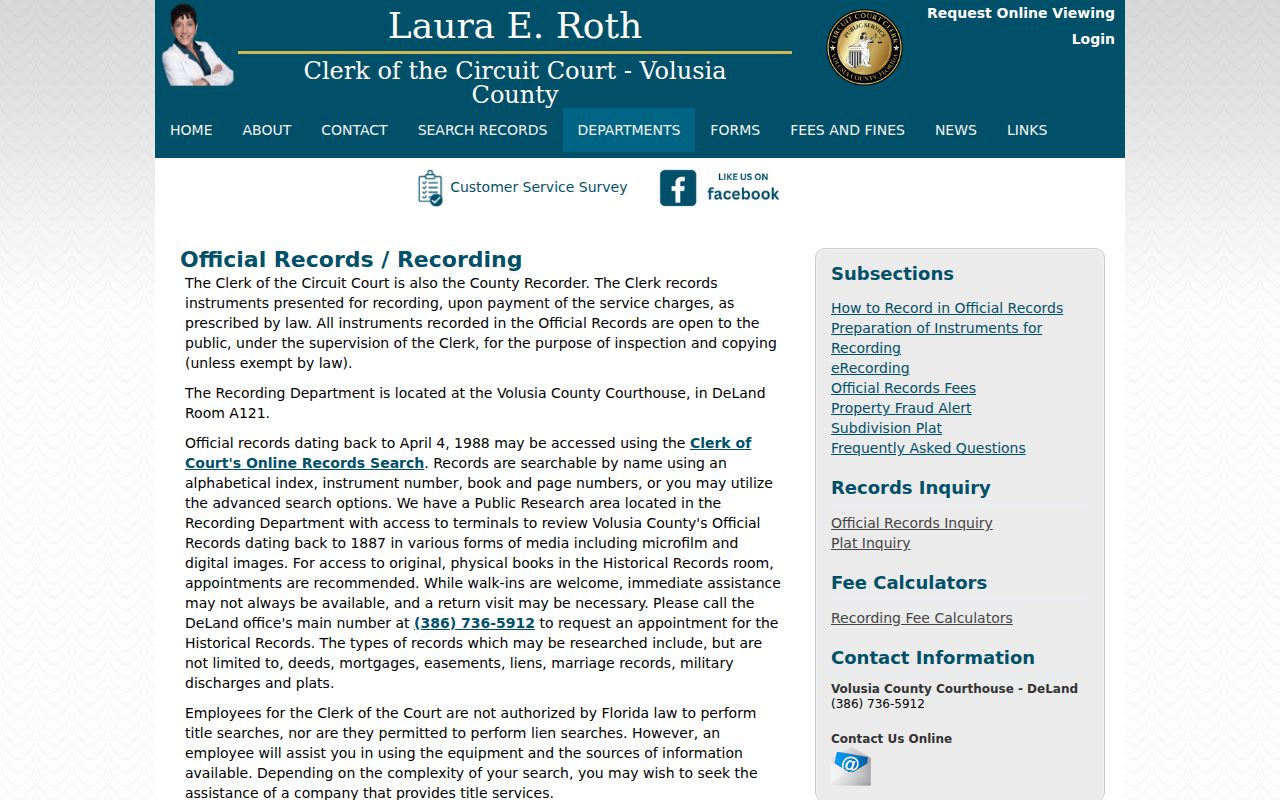
The captured page confirms that older title work has a courthouse route even when the web index stops.
Trace Volusia Deeds Backward
A chain of title is the sequence of recorded transfers for the same land. Work from the known present toward the unknown past. Names alone are not enough in Volusia County because two people can share a name and an old deed may omit the current street address. Match the legal description at each transfer and preserve every instrument citation.
- Open the current parcel card. Save the present owner, parcel keys, legal description, and latest deed citation.
- Retrieve that purchase deed. Record the buyer, seller, execution and recording dates, instrument or book/page, and land description.
- Search the seller, who is the grantor on this deed, as a grantee in an earlier time window. Confirm the same land.
- Repeat seller-as-earlier-buyer. Try initials, spouses, trusts, entities, and spelling variants when a link fails.
- When the chain reaches April 4, 1988, continue at DeLand Room A121 through the 1887-forward media.
- Grantor / grantee
- The grantor gives or sells an interest; the grantee receives it.
- Chain of title
- The linked set of transfers for the same parcel over time.
- Legal description
- Land wording such as subdivision, lot and block, or metes and bounds that identifies the parcel more durably than a street number.
- Instrument number
- The Recorder's unique filing reference for a recorded document.
The official search gate shown here is the starting screen for released web records.
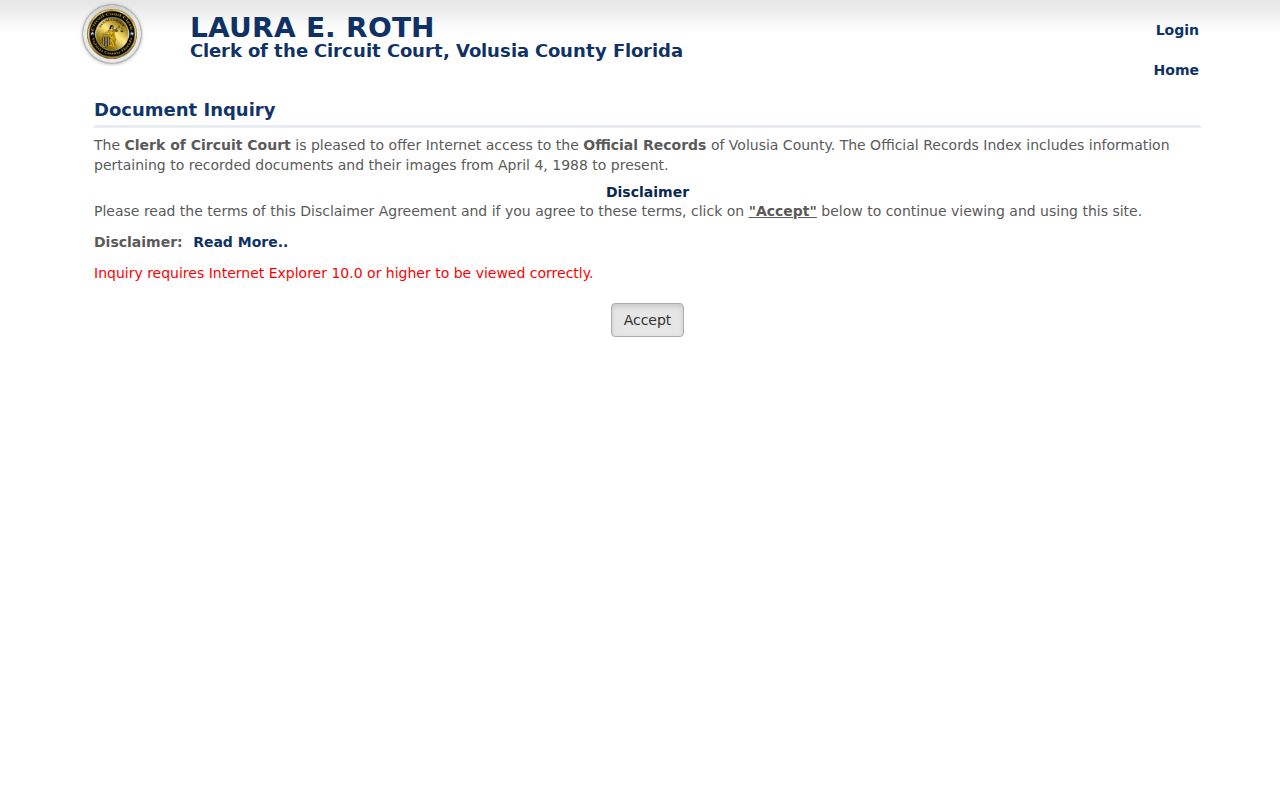
Accepting the disclaimer opens the search controls; retain the parcel and deed notes before each new name search.
Edgewater Records Cross a Cutoff
The exact online handoff is April 4, 1988. Earlier deeds are not a dead end. The Recording Department's public research area in Volusia County Courthouse Room A121, 101 N. Alabama Avenue in DeLand, has microfilm and digital sources back to 1887, staff assistance, and research terminals. Call 386-736-5912 before travel. Mail requests can go to the Recording Department at P.O. Box 6043, DeLand, FL 32721.
Edgewater is not the county seat, so a long title trail leaves the city. Clerk staff can help with equipment and sources, but they do not perform title searches or decide whether title is clear. A clerk search is listed at $2 per name per year. Bring a short list of grantor and grantee names, date ranges, book/page or instrument references, and the unchanged legal description. This preparation keeps work on the correct parcel.
Note: The courthouse media extend the Edgewater ownership trail 101 years earlier than the public web-image start date.
Keep Edgewater Legal Geography
The modern address is not the safe historic key. Street numbers may be assigned or reformatted, and annexation or subdivision work can change how a place is described. No authoritative Edgewater-wide renumbering year was found, so do not assume one. For a hard match, ask the City Clerk or Planning staff for address ordinances, annexation maps, or street-name resolutions tied to that specific parcel.
Carry the lot, block, subdivision, plat reference, or metes-and-bounds wording from deed to deed. A plat is the recorded map that lays out lots, blocks, streets, and easements. Parcel ID and Alternate Key work well in the current county system, but old books depend more on names and legal land text. This method also handles a structure that predates its present street number.
Edgewater Permits Date the House
Ownership dates do not tell when a structure appeared or changed. Edgewater permit records can add construction, alteration, inspection, and certificate-of-occupancy events. The city's online status function expects a known permit number. When only an address and date range are known, request the record from Building rather than concluding that nothing exists online. Notices of commencement and construction liens may also appear in Clerk Official Records.
The Edgewater forms and applications page shown below is one city access point for building records.
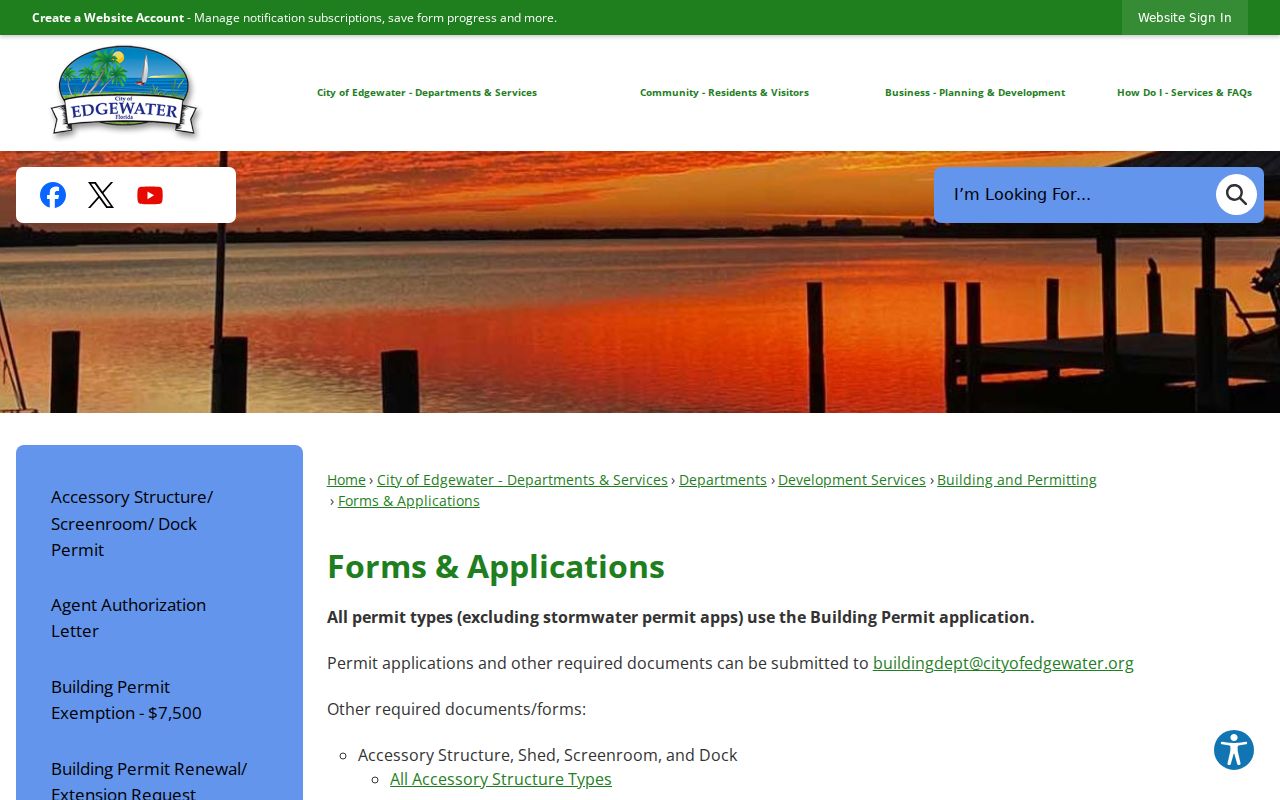
The city has not published the earliest retained or digitized permit year, so a focused request should state the property address, parcel identifier, record type, and date span.
Pair Edgewater Directories and Census
Deeds name owners. Directories and census schedules can identify people who actually occupied an Edgewater address, including those who never held title. The verified directory run is cataloged under New Smyrna Beach even though it expressly includes Edgewater. It covers editions from 1947 through 1960 with stated gaps, and the underlying publisher is not verified. Search both place names.
- Place each deed owner and address on a dated timeline.
- Check the nearest available Edgewater-inclusive directory edition under New Smyrna Beach.
- Compare the 1947, 1950, 1954, and 1956 points with the public 1950 census.
- Use household names and nearby addresses to resolve spelling or enumeration problems.
- Mark every gap. Do not assume the same household stayed between surviving editions.
Federal census schedules are public through 1950 under the 72-year rule. An enumeration district is the small area assigned to one census taker, and address detail can vary. Volusia County Public Library offers in-branch Ancestry Library Edition plus HeritageQuest, while the National Archives states the release rule. The collection details belong on the Edgewater city directory page; here they serve only as points on one address timeline.
Before Edgewater Records Began
A Florida Memory WPA history reports that fire destroyed records at Mellonville around 1849. That loss concerns territorial-era custody, not the later Volusia Official Records run. Volusia County was created in 1854, marriage records reach 1855, and the courthouse land-research media begin in 1887. These dates explain why sources do not all begin together.
Edgewater itself also had several names and civic stages. Hawks Park dates to 1871, the Town of Edgewater incorporated in 1924, and the City of Edgewater incorporated in 1951. The confirmed directory run crosses that 1951 change. Older text searches may therefore require Hawks Park or New Smyrna Beach as well as Edgewater.
Close Edgewater Household Gaps
When a previous owner dies, probate can explain the next transfer. The Volusia Clerk's Probate and Guardianship division keeps estates, wills, trusts, guardianships, and disposition proceedings. Search public probate dockets by name, then connect any deed signed by a personal representative or trustee to the same legal parcel. Some documents and case types remain confidential, so a docket gap does not prove there was no estate.
Obituaries may connect relatives, former places, and civic ties. They are memorial notices, not certified vital records, and should be checked against the deed and probate trail. The Cardwell obituary archive is a local Edgewater source.
The archive can supply a search lead when a former owner's name ends at an estate, but it cannot establish that every named relative lived at the house.
Lawful use. Research previous residents for Edgewater house history, genealogy, or estate questions. Never use a record trail to watch, harass, threaten, or expose a living person's protected location.
A final timeline should distinguish facts from inferences. Deeds prove recorded interests, assessor records show assessed ownership, directories and census schedules report people in a given edition or enumeration, and permits document work. Together they can show who lived here before without pretending any one source is a complete household roll.